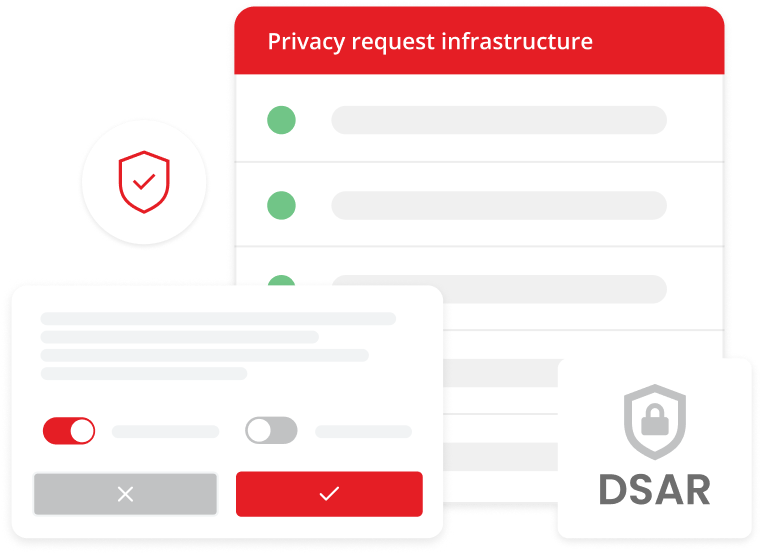
Structured request handling without manual overhead
This is not a form builder. It is a controlled intake and validation layer that behaves predictably in production environments.
Step 1: Embed the widget
Deploy a lightweight script on any page. The widget runs in isolation to avoid conflicts and supports multilingual environments out of the box
Step 2: Verify identity
Requests remain inactive until verified. Email-based confirmation ensures only legitimate requests enter your workflow and defines when compliance timelines begin.
Step 3: Manage requests centrally
Track requests across domains, filter by type, and assign internal systems. Deadlines are visible and enforced within the workflow.
Step 4: Deliver encrypted disclosures
Files are collected, encrypted, and delivered through expiring download links. No manual file handling or insecure transfers.
Built for Developers, Designed for Control
This is not a form builder. It is a controlled intake and validation layer that behaves predictably in production environments.
Isolation by default
Runs inside a Shadow DOM component to prevent layout or styling conflicts.
Localization support
Automatically adapts to page language with override options when needed.
Structured request intake
Collects all required data, including support for on-behalf requests such as legal representatives.
Request validation pipeline
CSRF protection, origin validation, and domain key matching ensure only valid requests are accepted.
Operational control over every request
Most DSAR tools stop at submission. This system is built for handling what comes after.
System-based workflows
Attach internal systems such as billing, infrastructure, or HR tools to each request and track completion per system.
Blind-index search
Search encrypted personal data without exposing it. Names and emails are indexed securely, allowing retrieval without decryption.
Deadline enforcement
Track standard response windows with built-in support for extensions within regulatory limits.
Resolution standardization
Use templates to maintain consistent responses across request types.
Audit logging
Every action is recorded with timestamps, user attribution, and request history.
Zero-trust handling of personal data
The system is designed to reduce exposure at every stage, not just protect stored data.
End-to-end encryption
All personal data and files are encrypted using AES-256-GCM during storage and transfer.
S3 vault storage
Disclosure files are stored in a dedicated encrypted vault. Use the default secure setup or connect your own S3-compatible storage.
Data minimization
Files are not retained longer than necessary. Expired disclosures are automatically removed from storage.
Abuse prevention
Built-in protections including honeypot detection, rate limiting, and strict API validation reduce spam and automated misuse.
Frequently Asked Questions
After submission, the user receives a verification email. Only verified requests move forward, ensuring invalid or fraudulent submissions are filtered out.
Requests are validated through multiple layers including CSRF protection, origin checks, API key validation, and rate limiting. Automated abuse and spam are actively blocked.
Files are encrypted, bundled, and stored in a secure vault. Data subjects receive time-limited download links, and files are deleted after the retention period.
Yes. You can define internal systems and attach them to each request, ensuring a consistent process for collecting and reviewing data.
Yes. You can connect your own S3-compatible storage to control where files are stored and how long they are retained.
It can replace manual workflows entirely or be integrated into existing processes depending on how your team operates.